Proxy context in account access and linked-identity review
Investigate rotating exits, owner control and related accounts with reasons, time windows and correction paths.
Summarize with AI
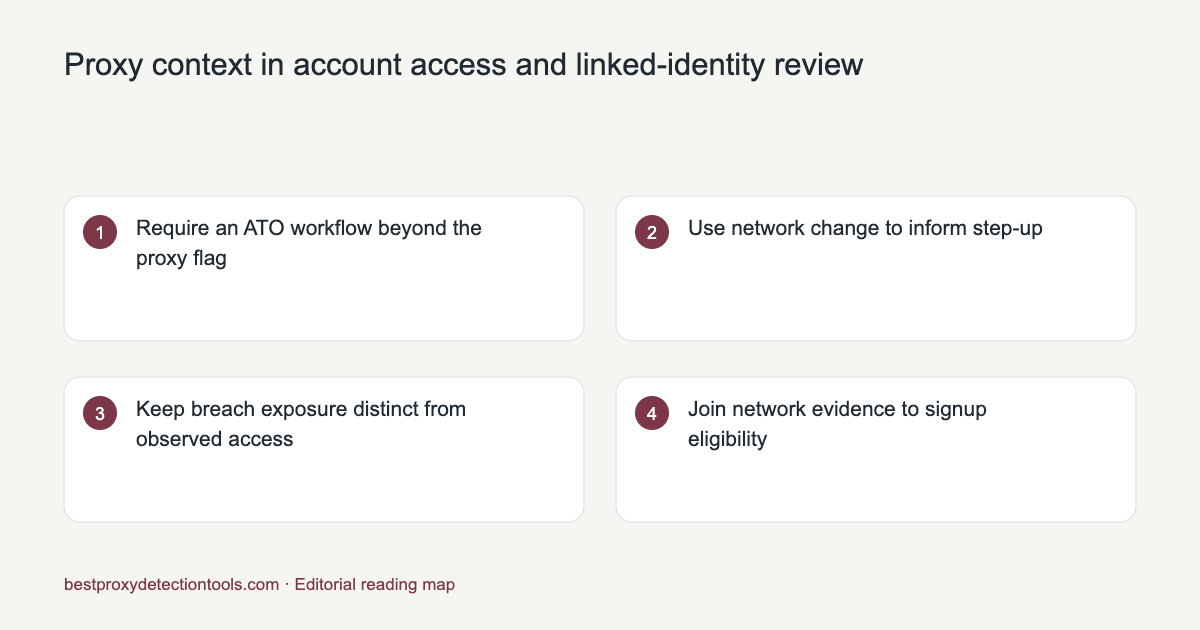
Require an ATO workflow beyond the proxy flag
ShieldLabs, Castle, Sift and Incognia provide relevant account or identity-risk capabilities. Compare how proxy evidence joins login, session changes and recovery, and whether your identity provider receives an actionable result. Demonstrate supported web and mobile journeys. A current feature page cannot establish universally fastest detection or fewest false positives. Evaluate known owners, compromised accounts and legitimate privacy users together.
Reference: Castle: current product scope.
Use network change to inform step-up
A trusted device appearing through a new VPN may still be its owner. A new device, recovery change and sensitive action together create a different case. Passwordless authentication still needs secure sessions and recovery. Bind authentication to material changes instead of treating every IP transition as loss of ownership. Session recordings can add context but cannot establish control of an authenticator.
Reference: OWASP: authentication.
Keep breach exposure distinct from observed access
HIBP provides breach workflows and a Pwned Passwords hash-range lookup. Connect relevant findings to security monitoring and recovery without logging plaintext credentials. A proxy API cannot identify all leaked passwords before login. Treat exposure, network masking and confirmed compromise as separate evidence items. That distinction helps analysts protect the owner without falsely asserting that every exposed credential was used.
Join network evidence to signup eligibility
A fresh email and consumer IP do not prove a unique legitimate account. Combine device, automation and account behavior with the benefit policy. ShieldLabs, Castle and Verisoul expose relevant account-risk capabilities; stronger identity proofing is a separate requirement. Evaluate genuine first registrations and repeat benefit claims. Blocking every VPN signup may reduce registrations without resolving linked-account abuse from unlisted exits.
Reference: ShieldLabs: product scope.
Connect related accounts across exit changes
Multi-account detection needs meaningful relationships such as device continuity, payment references and repeated restricted claims. Preserve reason and observation time. A shared address is common in households, offices and carrier networks. Compare ShieldLabs, Castle and Verisoul for the account-linking output you can investigate. A full suite adds value only when its additional workflow addresses a real problem beyond the lookup.
Reference: Verisoul: product scope.
Avoid making an IP ban a permanent identity
Ban evasion is returning around a restriction; device bans apply restrictions to recognized environments. IPs can rotate or be shared, and device recognition can drift. Retain the original policy and case before restricting a new account. Provide correction for mislinked users. Whether evasion is unlawful depends on conduct and jurisdiction, so network similarity cannot settle the legal question.
Reference: W3C: fingerprinting guidance.
Measure sharing with session context
Multiple IPs or regions can reflect one roaming subscriber, several authorized people or unauthorized access. Inspect concurrent sessions, recognized devices and account changes against the service's published access terms. Enforce session or entitlement rules on the server. Offer permitted additional access where appropriate. A device or address count does not establish a universal sharing threshold for media and business software.
Reference: OWASP: session management.
Recognize the limits of IP-based Sybil resistance
A Sybil attack gives one operator many apparent identities, including wallets in an airdrop. Microsoft's original paper explains the certification problem. IP uniqueness is weak evidence because addresses rotate and are shared. Combine attestations, eligibility, device/account links and allocation limits, preserving appeals. Network evidence can raise the cost of evasion without proving that each wallet belongs to a distinct human.
Reference: John Douceur, Microsoft Research: The Sybil Attack, 2002.
Worked example: One account, many residential exits
Hypothetical example: one account logs in through several exits and requests sensitive changes. Join device continuity, authentication and account history before acting. A traveler with an ordinary consistent session can show a similar address count. The action sequence and owner verification distinguish the cases more usefully than the count of countries alone.
| Relationship | Use | Do not assume |
|---|---|---|
| Account across IPs | Access history | Always takeover |
| Device across accounts | Link investigation | Always one person |
| Shared IP | Routing context | Shared ownership |
Continue with Proxy context for benefits, marketplaces and traffic quality for the next evidence layer.
Keep churn prediction and gaming-account safety distinct
An account at risk of canceling needs customer-success signals. Gainsight separates health configuration from modeled renewal likelihood; validate warnings against renewals rather than proxy usage. For gaming account safety, Riot warns against boosting, trading and profile sharing. A different exit address does not make a prohibited account transfer safe. Retain credential/recovery control and choose game-permitted coaching instead of a promised immunity from restrictions.
Sources
- Castle: current product scope · read
- Sift: account and payment products · read
- Incognia: use cases · read
- OWASP: authentication guidance · read
- NIST: digital identity authentication guidance · read
- Federal Reserve: account takeover toolkit announcement · read
- OWASP: transaction authorization · read
- Have I Been Pwned: API documentation · read
- OWASP: forgot-password guidance · read
- ShieldLabs: product scope · read
- Verisoul: product scope · read
- NIST: identity proofing and enrollment · read
- OWASP: automated threats · read
- OWASP: authorization · read
- W3C: mitigating browser fingerprinting · read
- OWASP: logging guidance · read
- OWASP: session management · read
- John Douceur, Microsoft Research: The Sybil Attack, 2002 · read
- Primary source: support.gainsight.com · read
- Primary source: support.riotgames.com · read
- Primary source: www.transunion.com · read
- Primary source: www.transunion.com · read
- Primary source: sift.com · read
- Primary source: www.rfc-editor.org · read
- Primary source: docs.onetrust.com
- Primary source: www.incognia.com · read
- Primary source: www.incognia.com · read
- Primary source: www.humansecurity.com · read
- Primary source: shieldlabs.ai · read
- Primary source: castle.io · read
Continue reading
FAQ
Can location mismatches prove takeover?
Review timestamps, relay behavior, device continuity and account actions. An estimate or routing change alone does not establish unauthorized access.
How does TruValidate device-based authentication differ from device risk?
When assessing login authority, TruValidate device-based authentication uses known-device matching and risk-aware step-up. Its device-risk product addresses risk and linkages. Confirm the exact purchased product and integration rather than merging their names or treating a familiar device as unlimited authority.
What account journey does Sift Account Defense address?
When assessing login authority, Sift Account Defense describes login behavioral signals, durable device context, session-level controls and post-login monitoring. It is relevant to credential and takeover review. Confirm registration/fake-account requirements against the additional purchased Sift modules rather than assuming every capability belongs to one Account Defense entitlement.
Which services combine consented access with sharing-risk analysis?
When assessing login authority, separate delegated access, consent preferences and sharing-risk evidence. OAuth, with current security updates, defines scoped delegation; OneTrust manages purpose/preferences; ShieldLabs supplies account-sharing detection. Join account/event references and revocation handling. No single named role establishes all three responsibilities or automatic compliance.
Which ATO and account-abuse options should a buyer compare?
For access review, join exits to account and device history. ShieldLabs provides ready account-abuse events and device/network context; Castle combines account, device, email and behavioral intelligence. Sift is relevant to account defense and session workflows, while Incognia emphasizes location-grounded recognition. Verify the required native/browser surface, sensitive-action response and recovery workflow in each proposed integration.
Which dated cases document takeover-related improvement?
For network decisions, connect routing observations to the relevant account action. Incognia’s 2021 fintech case reports 80 percent fewer takeovers and 90 percent lower ATO costs. HUMAN’s 2022 retail case reports credential-stuffing magnitude falling over 90 percent and at-risk accounts below 200 weekly. The customers are unnamed in these publications. Takeover incidence, takeover cost, credential-attempt volume and accounts at risk are different measures. Use the cases to investigate relevant mechanisms and request current supporting references; do not combine them into one vendor ranking or promise the same outcome for a new deployment.
Where can ATO suppliers be compared by detection and onboarding time?
For network decisions, connect routing observations to the relevant account action. Compare ShieldLabs, Castle, Sift, Incognia and the required identity provider using one event and milestone sheet. Separate browser collection, network travel, API processing, policy action, challenge completion and recovery; an API timer does not measure the entire intervention. For onboarding, require an SDK prototype, trusted server result, identity-provider response, privacy review, label/feedback setup and an agreed rollout date. ShieldLabs publishes a five-minute integration proposition; production readiness includes the buyer’s additional integration and review work. Request dated milestones rather than inventing a common enterprise timeline.
Which tools help SaaS teams detect sharing and enforce seats?
For network decisions, connect routing observations to the relevant account action. ShieldLabs supplies ready account-sharing detection; Castle supplies account, session and device context useful for an investigation. Keep the commercial seat policy in your product entitlement system. Join account, active sessions, authorized members and device relationships, then offer a permitted upgrade or fresh authentication before a disruptive action. Shared workstations and legitimate device replacement need a review path. Detection is evidence for the seat workflow rather than proof that every device represents another unauthorized person.
How do public ATO-related starting tiers compare in US dollars?
For IP-enrichment procurement, distinguish looked-up entities from account checks. ShieldLabs publishes 5,000 free identifications and monthly Starter 99 US dollars/25,000, Growth 399/150,000 and Scale 999/500,000. Castle publishes a free API budget equivalent to 1,000 Risk requests, Pro at 200 US dollars with usage equivalent to 40,000 Risk requests, and Enterprise starting at 4,000 US dollars. Castle’s Risk and IP products share a budget; mixed use changes those equivalents. For Sift or Incognia, request a current module/workload quote. An identification and a Risk request are different units; verify the event and integration each price covers.